Various Line Icons Creating a Minimalist
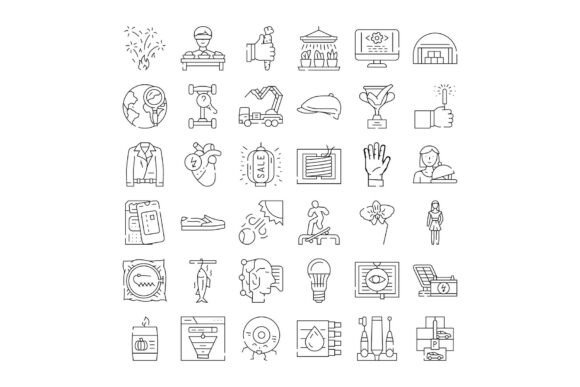
Minimalist line icons are clean, single-weight outlines that communicate ideas with clarity and restraint. Various Line Icons Creating a Minimalist refers to thoughtfully curated sets—often open or commercially licensed—designed for consistency, scalability, and adaptability across digital contexts. These aren’t just decorative flourishes; they’re functional visual shorthand: a calendar icon signaling scheduling, a speech bubble representing chat, or a gear denoting settings—all rendered in harmonious stroke weight, spacing, and proportion.
Why Simplicity Matters Across Roles
A well-crafted minimalist line icon set supports usability first. Its light visual footprint reduces cognitive load, speeds up recognition, and scales cleanly from tiny mobile buttons to large dashboard widgets. Unlike filled or gradient-heavy alternatives, line icons remain legible at small sizes, work reliably on varied backgrounds (light, dark, textured), and integrate smoothly into responsive layouts without extra CSS overrides.
For Beginners Building Their First Website or App
If you’re learning HTML, Figma, or WordPress, Various Line Icons Creating a Minimalist lowers the barrier to professional-looking design. You don’t need illustration skills—just copy-paste SVG code or import an icon font. A student building a portfolio site might use a simple envelope icon for contact info, or a magnifying glass for search—both instantly recognizable and easy to style with CSS color or hover effects. Priorities here include clear documentation, intuitive naming (e.g., icon-home, icon-user), and formats that work without build tools—like SVG sprites or downloadable ZIPs with PNG/SVG files.
For Designers & Developers Shipping Real Products
Professionals integrating icons into production interfaces care about precision and maintainability. They’ll check whether the set follows consistent metrics: uniform stroke width (typically 1.5–2px), standardized baseline alignment, and proper spacing around each glyph. A UI designer at a SaaS startup might audit how well the “sync” or “export” icon matches their existing iconography—and whether it renders crisply on high-DPI screens. Developers look for accessible markup (proper aria-hidden or role="img"), tree-shakable SVG imports, and compatibility with design systems like React or Vue components. Reliability matters more than quantity: 80 carefully crafted icons beat 300 inconsistent ones.
For Educators & Content Creators
Teachers making slide decks, infographics, or learning modules rely on icons to reinforce concepts visually—without distracting from core content. A biology instructor illustrating cell division might pair a minimalist “cycle” icon with text about mitosis; a language tutor could use speech, ear, and book icons to label listening, speaking, and reading activities. Here, meaning trumps trendiness: icons must be culturally neutral and unambiguous. An educator evaluating Various Line Icons Creating a Minimalist will scan for inclusive representation (e.g., diverse avatars, gender-neutral symbols) and avoid metaphors that assume specific tech literacy—like a floppy disk for “save.”
For Small Business Owners & Marketers
Time and budget shape decisions. A café owner updating their website might use a minimalist coffee cup, location pin, or clock icon to highlight hours, address, or menu—no need to hire an illustrator. A freelance marketer designing email headers or social media carousels values flexibility: can these icons be recolored to match brand palettes? Are they licensed for commercial use without attribution? Cost isn’t always about price—it’s about opportunity cost. Spending 90 minutes manually adjusting mismatched icons from free sites adds up faster than licensing one cohesive set upfront.
For Hobbyists & Creative Experimenters
Whether you’re sketching interface ideas in Figma, prototyping a Notion template, or customizing a Ghost blog theme, minimalist line icons invite play. Their simplicity makes them easy to modify: tweak stroke ends, add subtle animation on hover, or combine two icons (e.g., a cloud + arrow for “upload”) using vector tools. A hobbyist exploring generative art might use icon paths as input for code-based animations—valuing clean, well-structured SVG d attributes over complex nested groups. Creativity thrives when constraints are clear—not arbitrary.
What to Evaluate Before You Use One
Not all minimalist icon sets deliver the same value. Ask yourself:
- Consistency: Do icons share the same visual rhythm—even across categories like objects (lamp), actions (play), and status (warning)?
- Accessibility: Are icons paired with text labels in real usage? Do SVGs include fallbacks or ARIA attributes where needed?
- Licensing: Can you use them in client work? In paid apps? In print materials? Check if attribution is required—and whether it fits your context.
- Format support: Do you need SVG code snippets, Figma libraries, NPM packages, or font files? Match the delivery to your workflow.
- Long-term fit: Will this set grow with your needs? Does the publisher update it regularly? Is there a community or support channel?
Real Uses, Not Just Theory
A freelance writer uses a minimalist “quote” icon to introduce testimonials on her personal site—styled in charcoal gray to match her serif headings. A nonprofit’s program coordinator selects a “handshake” and “globe” icon from the same set to visualize partnership and outreach goals in a grant report. A high school coding club builds a classroom dashboard with toggle switches, status dots, and navigation arrows—all from one line icon library—so students focus on logic, not pixel-perfect asset hunting.
None of these users needed advanced vector skills. What they shared was intent: to communicate clearly, move quickly, and keep attention on people and purpose—not decoration.
Does It Fit Your Next Step?
If your goal is to clarify, not complicate—if you value speed without sacrificing polish—if your audience includes people scanning on phones, reading in low-light, or navigating with assistive tech—then Various Line Icons Creating a Minimalist is more than aesthetic preference. It’s infrastructure for understanding. It works whether you’re sketching wireframes at 7 a.m., debugging CSS at midnight, or choosing visuals for a community newsletter.
You don’t need to love minimalism to benefit from it. You just need to care that your message lands—cleanly, confidently, and without friction.