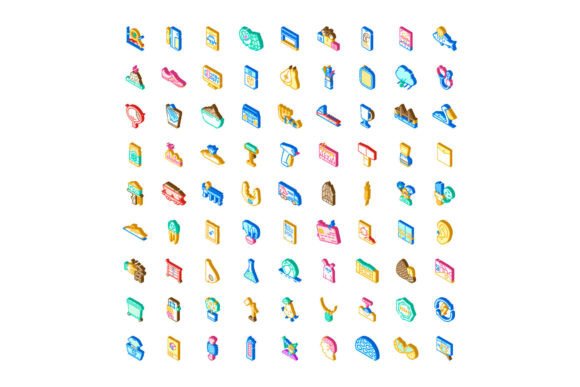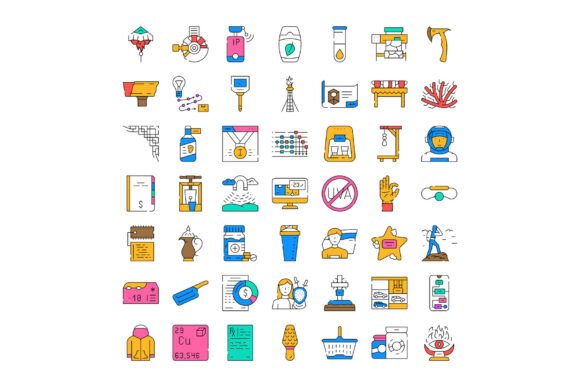
Diverse Icon Set Representing Various Co
Icons are no longer decorative afterthoughts—they’re functional infrastructure. In today’s fast-paced digital landscape, where attention spans shrink and interface clarity matters more than ever, a well-chosen icon can replace three sentences, accelerate comprehension, and reinforce brand voice—all in under 24 pixels. The Diverse Icon Set Representing Various Co responds directly to this reality: it’s not just another pack of generic symbols, but a thoughtfully curated collection of line icons spanning industries, hobbies, objects, and abstract ideas—designed for real-world use in web design, applications, and infographics.
Why “Diverse” Isn’t Just a Buzzword Here
Modern digital products serve global, multigenerational, and multidimensional audiences. A fintech dashboard isn’t used only by accountants—it’s also accessed by small-business owners managing payroll, educators tracking grant funds, or freelancers reconciling invoices. Likewise, a wellness app serves clinicians, yoga instructors, nutrition coaches, and users with varying health literacy levels. Generic icons—like a single “gear” for all settings or a vague “lightbulb” for every idea—fail these contexts. The Diverse Icon Set Representing Various Co avoids that pitfall by offering specificity without sacrificing consistency: distinct icons for “supply chain,” “biofeedback,” “community garden,” “API integration,” “mindfulness journal,” and “circular economy”—each rendered in the same clean, scalable line style.
This diversity reflects an industry-wide shift from visual shorthand to semantic precision. Design systems now prioritize accessibility, localization, and contextual relevance over stylistic uniformity alone. When an icon represents “data privacy,” for example, the set includes options that subtly differentiate between encryption, consent management, and audit logging—supporting nuanced communication rather than oversimplification.
Evolving Alongside Real-World Workflows
Five years ago, many teams treated icon libraries as static assets—downloaded once, reused endlessly. Today, workflows are iterative, collaborative, and platform-agnostic. Designers hand off to developers via Figma plugins; marketers embed icons directly into CMS-driven landing pages; educators pull SVGs into interactive lesson builders. The Diverse Icon Set Representing Various Co is built for this fluidity: all icons are vector-based, properly named (e.g., icon-robotics-lab, icon-urban-farming), include accessible title attributes, and ship with both standalone SVG files and CSS-ready icon fonts.
It also mirrors how professionals actually work across domains. A sustainability consultant building a stakeholder map might need icons for “carbon offsetting,” “just transition,” and “material flow analysis.” A coding bootcamp instructor preparing slides on full-stack architecture could select from “GraphQL endpoint,” “container orchestration,” or “real-time database sync”—not just generic “server” or “cloud.” These aren’t niche edge cases; they’re daily needs for people solving tangible problems.
Meeting Modern Expectations—Without Overpromising
Users don’t ask for “more icons.” They ask for faster understanding, fewer cognitive detours, and interfaces that feel intuitive—not clever. That’s why line icons remain dominant: their minimalism supports scalability, responsive behavior, and high-contrast readability—especially critical for WCAG-compliant designs and low-bandwidth environments. The Diverse Icon Set Representing Various Co leans into this strength, avoiding heavy fills, intricate gradients, or animated variants that compromise performance or accessibility.
At the same time, it acknowledges growing expectations around representation and cultural resonance. Icons for “family” avoid rigid nuclear stereotypes; “remote work” includes inclusive depictions of co-working spaces, home offices with caregiving context, and asynchronous collaboration tools. “Education” covers everything from Montessori classrooms to MOOC dashboards to vocational training labs—not just chalkboards and graduation caps. These choices reflect research-backed observations about how people interpret visual metaphors, not assumptions.
Practical Use Across Roles and Contexts
How does this translate beyond theory? Consider three everyday scenarios:
- For product designers: Building a B2B SaaS tool for renewable energy cooperatives? Instead of cobbling together mismatched assets or commissioning custom icons for “grid resilience,” “community solar enrollment,” and “policy advocacy tracker,” you can deploy consistent, production-ready icons from the set—cutting design debt and speeding up usability testing.
- For content creators and educators: Developing an online course on ethical AI? Pulling precise icons for “bias auditing,” “model explainability,” and “human-in-the-loop validation” helps learners grasp distinctions quickly—without relying solely on text-heavy explanations.
- For small business owners and marketers: Updating a local bakery’s website to highlight new offerings like sourdough subscriptions, compostable packaging, and weekend baking workshops? The set includes icons for “subscription model,” “zero-waste certification,” and “hands-on workshop”—enabling visual storytelling that aligns with actual services, not stock-photo clichés.
None of these uses require mastery of illustration or iconography theory. They rely instead on thoughtful curation—matching symbol to meaning, not just aesthetic to mood.
Not Just for Designers—A Tool for Clarity at Every Level
Icons function as shared vocabulary. When a nonprofit’s internal dashboard uses the same icon for “donor stewardship” as its public impact report does for “community engagement,” it builds coherence across touchpoints. When a developer sees a clearly labeled icon-climate-risk-assessment in the asset library, they spend less time reverse-engineering intent and more time implementing accurately. When a non-native English speaker scanning a multilingual app recognizes a universally legible icon for “emergency contact,” language barriers soften—not because the icon is “universal,” but because it was designed with linguistic and cultural variability in mind.
The Diverse Icon Set Representing Various Co supports this kind of cross-role alignment. Its naming convention, documentation, and categorization (by industry, function, and conceptual theme) make it navigable for writers drafting alt text, project managers estimating design sprints, or QA testers verifying icon usage across breakpoints.
Looking Ahead—Without Chasing Trends
Will AI generate perfect icons on demand someday? Possibly—but prompt engineering still struggles with semantic nuance, licensing ambiguity, and contextual fidelity. Will 3D or glass-morphism icons dominate? Only where appropriate—most enterprise, educational, and accessibility-first applications benefit more from clarity than novelty. What’s gaining steady traction—and what this set supports—is intentionality: choosing the right icon, for the right audience, at the right moment.
That intentionality extends to sustainability. All icons are optimized for minimal file size (under 1.2 KB SVG average), reducing page weight and improving Core Web Vitals. No unnecessary animations, no redundant variants, no bloat. It’s a quiet response to rising awareness about digital carbon footprints—and a reminder that responsible design includes technical efficiency, not just visual ethics.
Ultimately, the value of the Diverse Icon Set Representing Various Co lies not in volume, but in relevance. It doesn’t try to be everything to everyone. Instead, it offers a focused, adaptable foundation—one that grows more useful as your projects become more specific, your audience more varied, and your standards for clarity higher. Whether you’re sketching wireframes, building dashboards, designing presentations, or illustrating reports, it meets you where you are: not with hype, but with precision, practicality, and quiet confidence in the power of well-chosen lines.