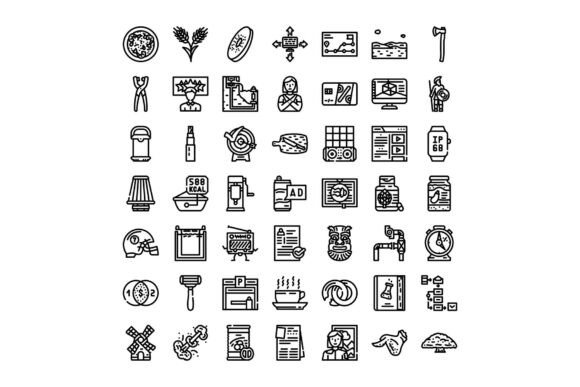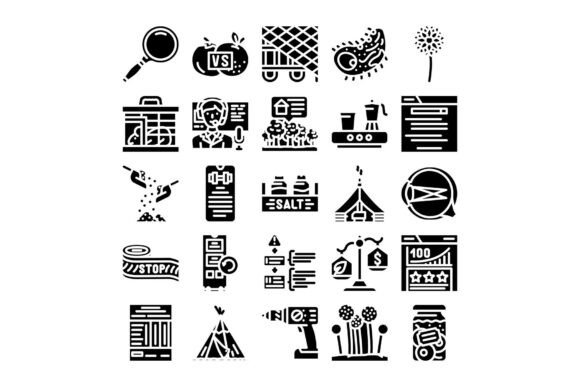
Collection of Various Glyph Icons Repres: Minimal, Versatile Symbols for Real-World Design Needs
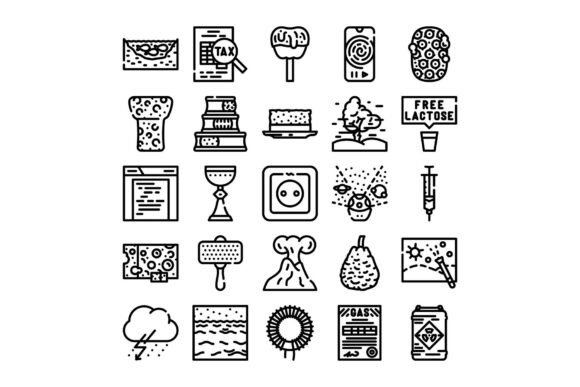
When you're building an infographic, refining a user interface, or illustrating a complex concept—clarity matters more than decoration. That’s where the Collection of Various Glyph Icons Repres steps in: a thoughtfully curated black and white glyph icon set designed not just to look clean, but to communicate instantly across business, technology, health, finance, agriculture, and nature contexts. These aren’t generic clipart-style icons. They’re purpose-built, minimal symbols engineered for legibility at small sizes, scalability across devices, and seamless integration into professional workflows.
Many designers, product managers, educators, and content creators face recurring challenges: inconsistent visual language across reports, time lost sourcing or custom-drawing icons for each new project, or icons that fail to resonate with diverse audiences—especially when representing nuanced topics like sustainable farming, telehealth platforms, or fintech dashboards. The Collection of Various Glyph Icons Repres directly addresses these pain points by offering a unified, context-aware visual vocabulary grounded in simplicity and semantic clarity.
Why Minimal Black and White Glyphs Work Where Others Fall Short
Colorful icons often clash with brand palettes or accessibility requirements. Overly detailed illustrations distract from data or messaging. In contrast, the Collection of Various Glyph Icons Repres uses restrained line work, balanced negative space, and intentional abstraction—making each symbol instantly recognizable without relying on color cues or stylistic flourishes. This makes them especially effective for:
- Infographics: Icons scale cleanly from social media thumbnails to large-format print, maintaining sharpness and meaning at every size.
- UI and dashboard design: Consistent stroke weight and proportional spacing ensure harmony alongside typography and interactive elements.
- Educational and advocacy materials: Neutral styling avoids cultural or emotional bias—ideal for global health campaigns or agricultural extension resources.
For example, the “water cycle” glyph doesn’t depict clouds and raindrops literally—it uses three interlocking arcs to suggest movement, renewal, and balance. Similarly, the “digital ledger” icon abstracts blockchain concepts into a clean, stacked rectangle with subtle connection lines—communicating security and structure without technical jargon.
Practical Applications Across Industries
The strength of the Collection of Various Glyph Icons Repres lies in its cross-domain relevance—not as a one-size-fits-all library, but as a flexible toolkit shaped by real-world use cases.
Business & Technology
Product teams use these glyphs to label navigation items, status indicators, or feature cards in SaaS interfaces. Because the set includes symbols for cloud sync, API integration, workflow automation, and secure authentication—all rendered in the same visual grammar—the UI feels cohesive, even as functionality expands.
Health & Public Wellness
Healthcare communicators rely on universally understood symbols for vaccination schedules, remote monitoring, mental wellness, and preventive care. The Collection of Various Glyph Icons Repres avoids medical clichés (like red crosses or stethoscopes) in favor of human-centered abstractions—such as a figure seated in stillness for mindfulness, or intersecting waveforms for biometric data—supporting inclusive, stigma-free messaging.
Finance & Sustainability
From ESG reporting dashboards to microfinance platforms, financial literacy tools benefit from icons that convey trust, growth, and accountability without leaning on outdated tropes (e.g., dollar signs or piggy banks). The collection includes glyphs for carbon footprint tracking, portfolio diversification, ethical sourcing, and digital payments—each designed to support narrative clarity, not visual noise.
Agriculture & Nature
Rural extension services, agri-tech startups, and conservation NGOs find value in icons that reflect both traditional knowledge and modern innovation—like a glyph merging a seedling and circuit pattern for smart irrigation, or layered soil strata with sun rays for regenerative land use. These symbols help bridge technical concepts with community-level understanding.
How to Use the Collection Effectively
Getting maximum value from the Collection of Various Glyph Icons Repres isn’t about using *all* the icons—it’s about selecting the right ones, consistently and intentionally.
- Start with function, not aesthetics: Before choosing an icon, ask, “What action or idea must this support?” If it’s guiding users to a ‘report incident’ feature in a safety app, prioritize clarity over novelty—even if the glyph looks simpler than alternatives.
- Maintain visual hierarchy: Pair glyphs with concise labels, especially in multilingual contexts. A black-and-white glyph paired with clear text improves comprehension more than a standalone decorative icon ever could.
- Test for context: An icon that reads clearly on a desktop dashboard may blur on a mobile notification. Preview glyphs at 16px, 24px, and 48px—and verify legibility against common background colors and textures.
- Respect accessibility standards: Since these are monochrome glyphs, ensure sufficient contrast (at least 4.5:1 against backgrounds) and always include descriptive alt text in digital implementations.
Different Users, Shared Goals
A UX designer might integrate the Collection of Various Glyph Icons Repres into a design system to accelerate prototyping. A nonprofit program officer may use them to visualize impact metrics in annual reports—reducing reliance on stock photography while reinforcing mission-aligned values. An educator building climate literacy modules could combine the “wind turbine,” “soil health,” and “community network” glyphs to illustrate interconnected systems thinking.
What unites these users isn’t technical skill—it’s a shared need for trustworthy, reusable visual tools that save time, reduce ambiguity, and uphold professional credibility. The Collection of Various Glyph Icons Repres meets that need by prioritizing utility over ornamentation, consistency over variety, and meaning over memorability.
A Resource Built for Implementation—Not Just Inspiration
This isn’t a gallery of isolated assets waiting for the “perfect project.” The Collection of Various Glyph Icons Repres is structured for immediate adoption: organized by domain and function, available in scalable vector formats (SVG, EPS), and compatible with Figma, Adobe XD, Sketch, and web development pipelines. Each glyph follows consistent artboard sizing, alignment, and naming conventions—so whether you’re importing into CSS, embedding via , or placing in a PDF report, integration is predictable and frictionless.
Importantly, the collection evolves with user feedback—not algorithmic trends. Updates reflect real requests: a new glyph for decentralized identity, refined versions of emergency response symbols, or expanded representations of inclusive healthcare access. That responsiveness ensures long-term relevance, not just short-term novelty.
If your work depends on communicating complex ideas simply—if you’ve ever spent hours tweaking an icon only to realize it still doesn’t say what you need—it’s worth reconsidering how foundational visual tools shape understanding. The Collection of Various Glyph Icons Repres offers more than symbols. It offers clarity, efficiency, and quiet confidence—every time you choose the right glyph, place it well, and let it do its job.