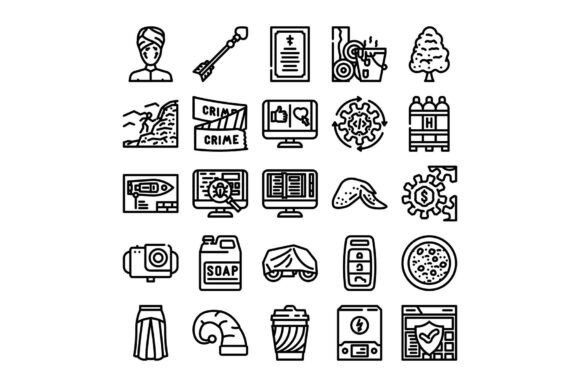
Collection of Miscellaneous Outlined Ico: A Practical Guide for Designers and Developers
A Collection of Miscellaneous Outlined Ico refers to a curated set of simple, linear vector icons rendered in outline style—clean, scalable, and consistently styled on a white background. Unlike themed icon packs focused solely on finance, weather, or navigation, this collection deliberately spans objects, abstract concepts, and everyday activities: a lightbulb for ideas, a handshake for collaboration, a clipboard for tasks, a globe for connectivity, or a gear for settings. Its defining trait is breadth without thematic constraint—designed not to replace specialized sets, but to fill gaps where generic, neutral, and instantly legible symbols are needed.
What Makes This Collection Distinct From Other Icon Resources
Most icon libraries fall into one of two categories: highly specific (e.g., medical, fintech, or education-themed sets) or stylistically dense (filled, gradient, 3D, or duotone icons). A Collection of Miscellaneous Outlined Ico occupies a middle ground—intentionally minimal, monoline, and context-agnostic. Each symbol prioritizes recognizability over ornamentation: the outline weight remains uniform across all icons, stroke joins are crisp and consistent, and negative space is carefully balanced to avoid visual noise at small sizes.
This consistency supports rapid UI assembly. For example, a dashboard needing both “user engagement” (represented by a chart with rising arrows) and “content moderation” (a shield with a checkmark) can pull from the same set without introducing visual dissonance. In contrast, mixing icons from multiple free sources often creates subtle mismatches in line thickness, corner radius, or optical sizing—issues that compound during responsive scaling or dark-mode adaptation.
How It Compares With Broader Icon Ecosystems
When evaluating icon resources, designers often weigh three dimensions: coverage, consistency, and integration readiness. A Collection of Miscellaneous Outlined Ico excels in consistency and integration but offers moderate coverage—by design. It won’t include every possible variant of a shopping cart or calendar, nor does it aim to cover niche domains like biotech or aviation. Instead, it focuses on high-frequency, cross-domain concepts: time, status, action, relationship, data, and environment.
Compared to open-source icon libraries like Feather or Heroicons, this collection typically includes fewer total icons (often 150–400), but each has been hand-reviewed for proportional harmony and semantic clarity. That curation reduces decision fatigue when selecting symbols for infographics or onboarding flows—especially where conceptual accuracy matters more than visual novelty. For instance, an icon representing “feedback” might appear as a speech bubble with a subtle arrow pointing inward, rather than a generic comment icon borrowed from a messaging app.
Unlike SVG sprite sheets generated from design tools, a well-structured Collection of Miscellaneous Outlined Ico usually ships with standardized naming conventions (e.g., icon-user-check, icon-file-export) and metadata supporting automated import into Figma, Sketch, or code-based tooling. That attention to developer handoff distinguishes it from ad-hoc icon bundles found on general asset marketplaces.
Strengths and Real-World Fit
The primary strength of a Collection of Miscellaneous Outlined Ico lies in its adaptability across roles and stages of development:
- UI designers use it to maintain visual rhythm in wireframes and high-fidelity mockups—especially when iterating rapidly across product areas like admin panels, analytics dashboards, or multi-step forms.
- Frontend developers benefit from predictable SVG structure: no embedded CSS, no unnecessary groups, and consistent viewBox dimensions—making it easier to apply global styling via CSS variables or React props.
- Content strategists and technical writers rely on it for annotated diagrams, process documentation, or accessible tooltips—where symbolic meaning must remain unambiguous across languages and literacy levels.
Consider a SaaS platform launching a new reporting module. Rather than commissioning custom icons for “data source,” “filter criteria,” and “export format,” the team can select matching symbols from a Collection of Miscellaneous Outlined Ico. The result feels cohesive—not because every icon was designed together for that exact use case, but because they share underlying construction principles.
Tradeoffs and Limitations to Acknowledge
No icon set serves every need equally. A Collection of Miscellaneous Outlined Ico trades depth for versatility. If your project requires nuanced representation—such as distinguishing between “pending review,” “approved,” and “rejected” states with distinct visual metaphors—you may still need custom illustration or supplemental glyphs.
It also assumes a baseline level of icon literacy. While symbols like a magnifying glass for search or a bell for notifications are near-universal, others—like a stylized atom for “modularity” or intersecting circles for “integration”—may require contextual labeling, especially in global or low-digital-literacy audiences. This isn’t a flaw in the collection itself, but a reminder that icon effectiveness depends as much on implementation as selection.
Additionally, because these icons are intentionally neutral, they rarely convey brand personality. A fintech startup aiming to express trust through warmth and approachability may find the starkness of outlined icons too reserved—opting instead for slightly rounded strokes or subtle weight variation. In such cases, the Collection of Miscellaneous Outlined Ico serves best as a functional foundation, not a final stylistic statement.
When It’s the Right Choice—and When to Look Elsewhere
A Collection of Miscellaneous Outlined Ico fits best when you value speed, scalability, and cross-functional alignment over stylistic uniqueness. It’s particularly effective for:
- Internal tools and admin interfaces where usability and clarity outweigh branding goals;
- Prototypes and MVPs where visual polish is secondary to functionality testing;
- Infographics requiring clean, label-agnostic symbols that scale across print and digital;
- Design systems aiming for extensibility—where new icons can be added without disrupting visual hierarchy.
Conversely, consider alternatives if:
- Your interface relies heavily on emotional resonance—for example, a mental wellness app where soft curves and gentle gradients support tone;
- You need icons with built-in accessibility features like dual-tone variants for high-contrast mode;
- Your domain demands precise, domain-specific metaphors—such as surgical instruments for a healthcare platform—that fall outside general-purpose scope;
- You’re working under tight licensing constraints and require explicit attribution-free redistribution rights beyond standard commercial use.
In those situations, pairing a Collection of Miscellaneous Outlined Ico with targeted custom work—or selecting a more narrowly scoped, domain-optimized set—often yields better long-term outcomes than forcing a broad resource to carry disproportionate weight.
Making a Grounded Decision
Evaluating a Collection of Miscellaneous Outlined Ico isn’t about finding the “best” icon pack—it’s about matching structural qualities to real project constraints. Ask yourself: How much time can we invest in icon selection and refinement? What level of visual consistency do stakeholders expect across platforms? Do our users interact with these symbols in isolation—or always alongside text labels?
Reviewing a sample of 20–30 icons from the collection in actual UI contexts—scaled down to 16px, viewed in grayscale, tested alongside your typeface—reveals more than any feature list. Does the “settings” icon remain distinguishable next to “notifications” at small sizes? Does the “upload” symbol avoid confusion with “download” or “sync”? These practical checks matter more than total count or stylistic pedigree.
Ultimately, a Collection of Miscellaneous Outlined Ico works not because it solves every problem, but because it solves common ones reliably—leaving room for intentional exception, not accidental inconsistency.